Impact : ★★★★☆
Space : ★★★☆☆
Originality : ★★★★☆
I entered teamLab’s digital art space, still skeptical. One image caught my eye, and I stopped. Before I knew it, tears came to my eyes.
This is a digital art space in Tokyo. Some call it a museum, others an attraction. It showcases works by teamLab, a group—not a single artist—that creates digital art. They are a company of experts who design digital works and present them as immersive spaces.
The company was founded in 2001 and fully entered the digital art field after 2010. It is especially popular overseas. There is no doubt that teamLab stands at the forefront of digital art.
In Tokyo, teamLab runs two locations. Here, I focus on teamLab Borderless at Azabudai Hills, which opened in February 2024.

For people who love traditional art, it is natural to feel some resistance to digital art. I tend to feel the same. Digital art often feels culturally shallow. I cannot see—or can barely see—the ideas behind it. It also seems to lean toward popular, child-friendly styles. When I think of digital art, I imagine kids crowding around the works.
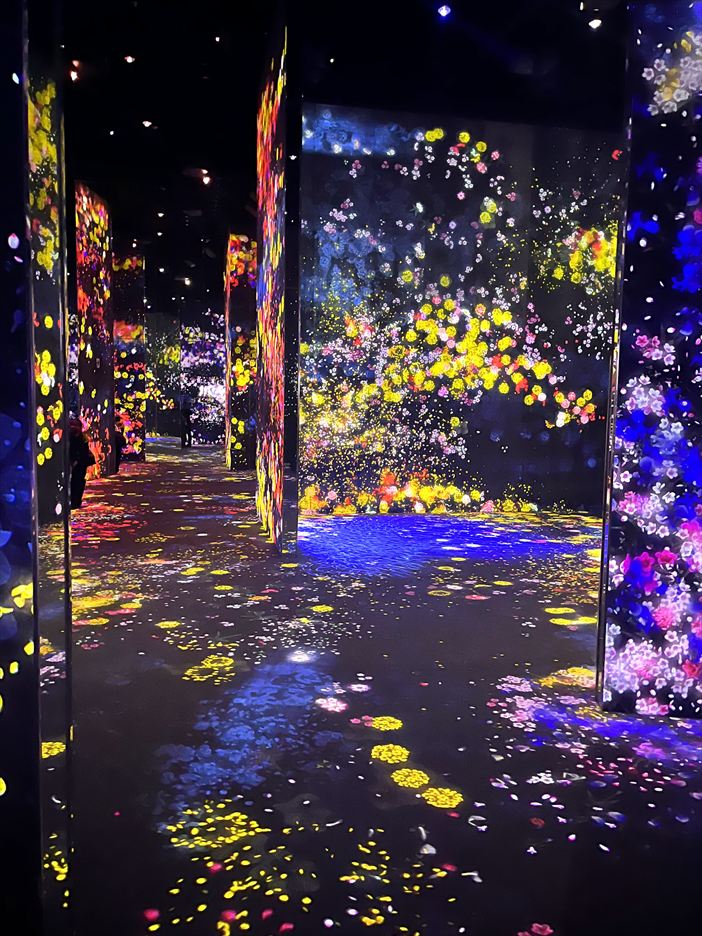
First, I want to share my initial impression of teamLab Borderless. It broke some of my preconceptions about digital art. The space was truly amazing. At one point, I watched a scene that moved me to tears—something I did not expect. Later, I realized it was because I could see the thought behind the digital work. I hadn’t planned to write about teamLab, but this perspective made me want to share my experience.
Now, I want to describe the museum itself.
The museum is in the heart of Tokyo, at Azabudai Hills, which opened in 2023. This area mixes residences and shopping, and it is close to Roppongi. Tokyo Tower is about a five-minute walk away. In short, it caters to a high-end crowd and has a somewhat exclusive, upscale vibe. Prices are high for everyday visitors, and the shops offer items that feel a bit out of the ordinary.
teamLab Borderless is located on the basement floor of this complex. The entrance is surprisingly hard to find. I felt this might be related to the overall layout of Azabudai Hills, which is itself confusing to navigate.
Since it is on the basement floor, there is no visible exterior. Tickets must be bought online for a specific time, so there is no ticket counter (though there is a service desk). A staff member stands at the entrance, and I show my QR code on my phone. Automatic doors open, and inside is a gate where I scan the QR code again. Once a group gathers, another automatic door opens, letting us enter the main area, where a screen gives a brief explanation. The process gives a slight feeling of an amusement park attraction.
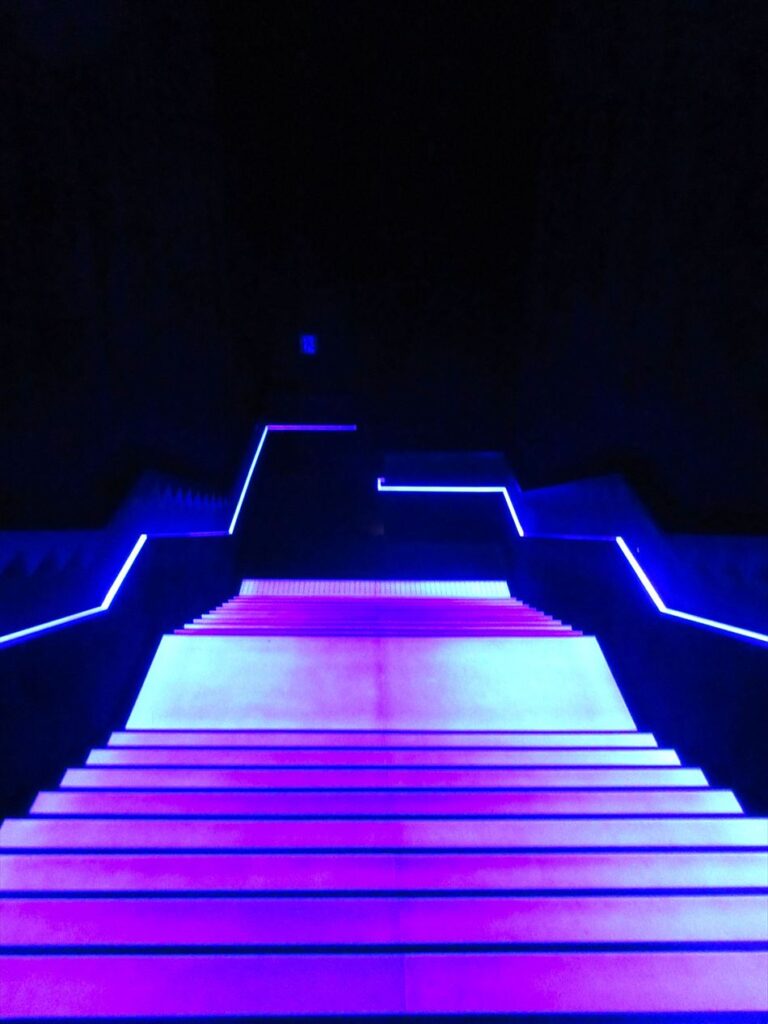
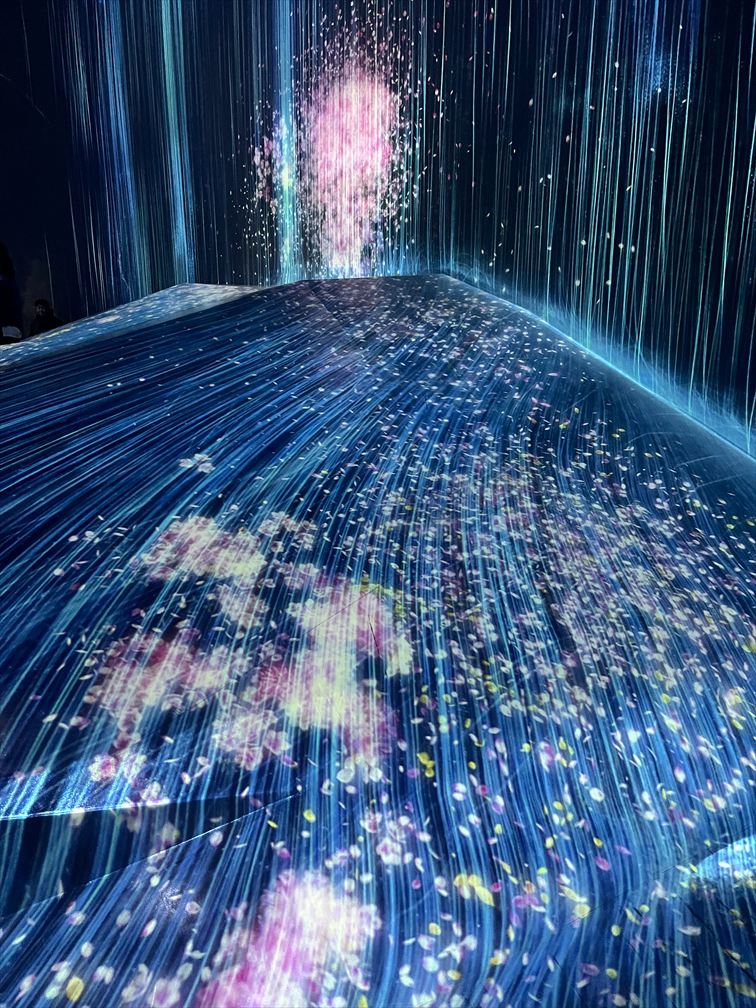
I then walked down stairs lit by LEDs into the dark museum. Inside, there is almost no lighting. Digital art is projected on the walls, and the light from the artworks guides the way.
What amazed me most was that the digital art covers the walls from floor to ceiling. Since it is digital, it needs projectors, but they are carefully placed on the ceiling or hidden spots.
The colorful designs mostly feature elements inspired by Japanese culture: flowers, trees, water, fish, birds, and animals. One key aspect of Japanese culture is harmony with nature, and I think this idea forms the foundation of the artworks.
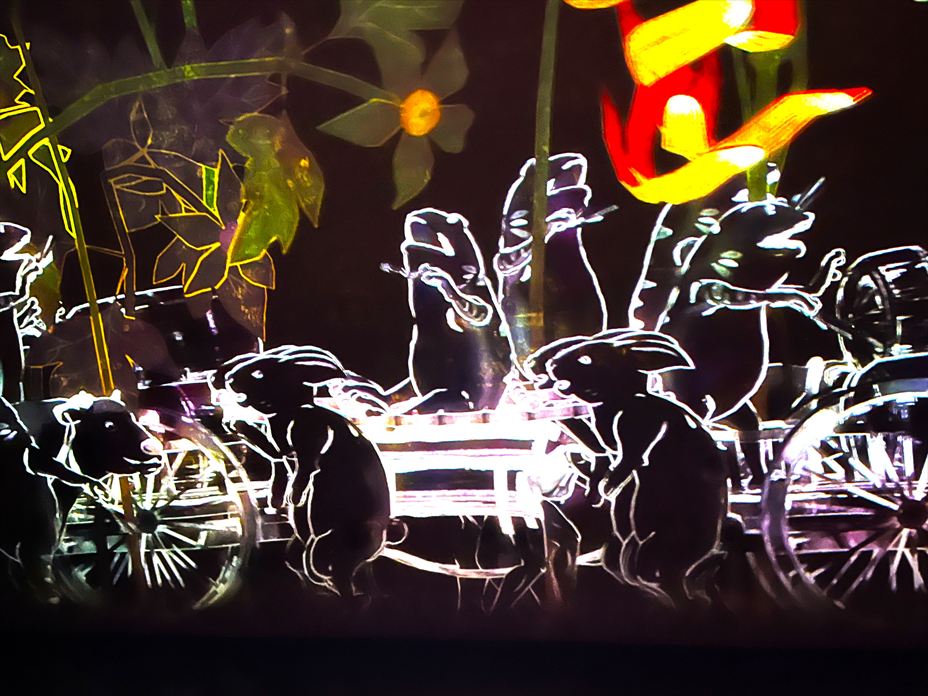
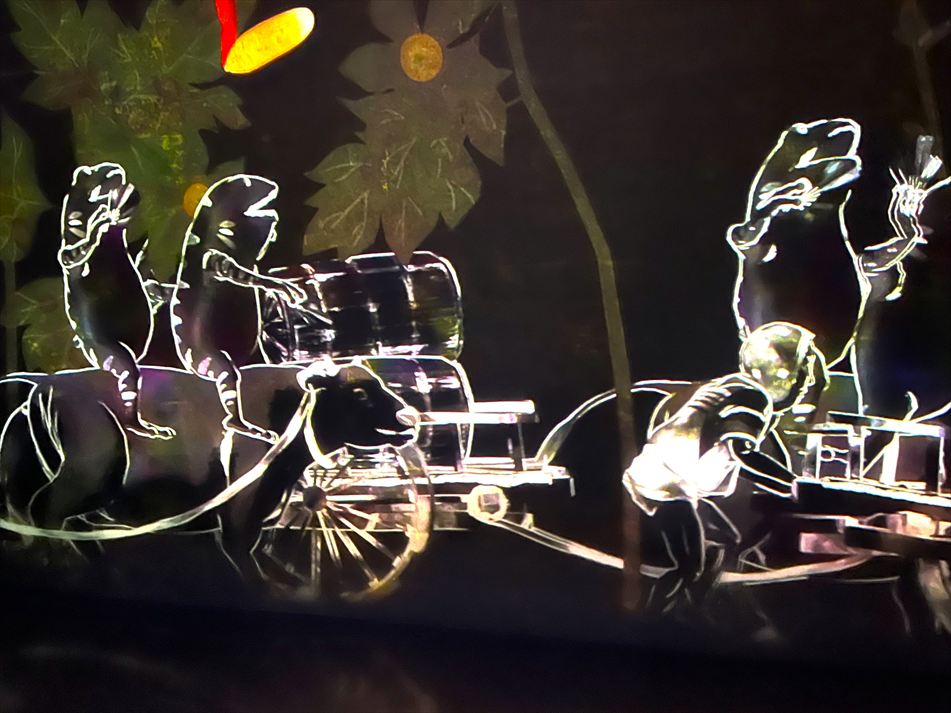
What moved me most was the video of humans and animals on the walls. Simple line drawings of people and animals walked across the space. I saw frogs, rabbits, bears, boars, and cows walking alongside humans. This perfectly reflects a core idea in Japanese culture: harmony between humans and nature.
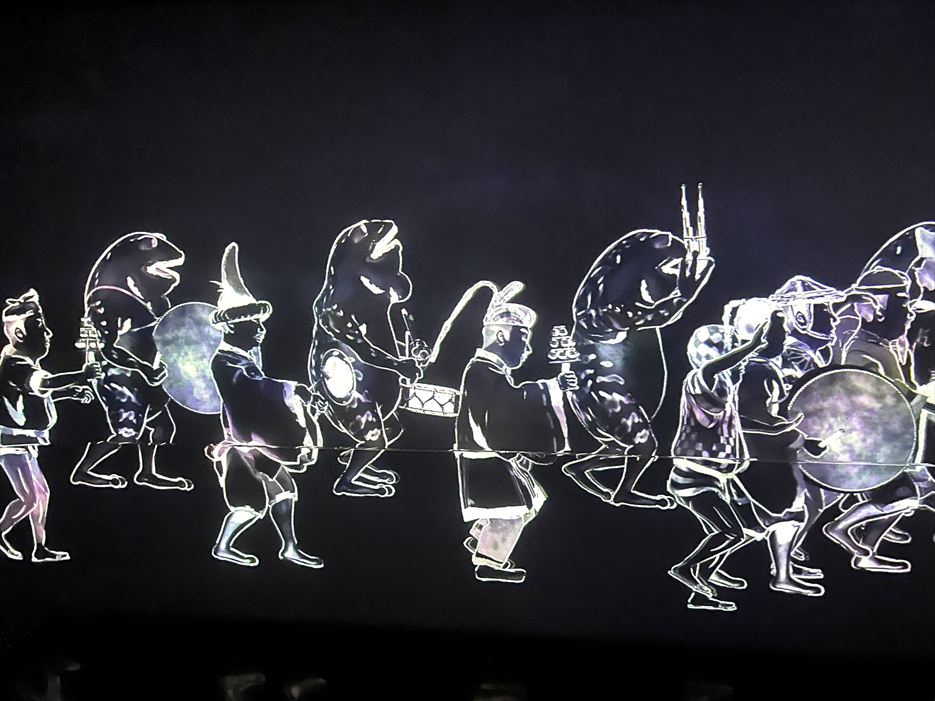
Anyone who loves Japanese history would likely think of the “Chōjū-giga” scrolls from the 12th–13th centuries, often called the origin of manga. The connection between this historical reference and the moving digital art is what probably brought tears to my eyes.
The museum has no map, and visitors can move freely. There are separated areas, and staff stand near the entrances, but you can enter any space. The works mostly use video, mirrors, and light. I noticed they use mirrors a lot. Some rooms reminded me of spaces by Yayoi Kusama, who is known for objects, light, and mirrors. They are clearly influenced by her work.
I think there are about ten different spaces, each with its own concept. All of them are clearly well thought out. “Artwork” might not be the right word—“immersive spaces” feels more accurate.
Videos and images of the spaces are shared on the website and social media, so you can check those. Here, I will focus only on the works and spaces that personally caught my attention.
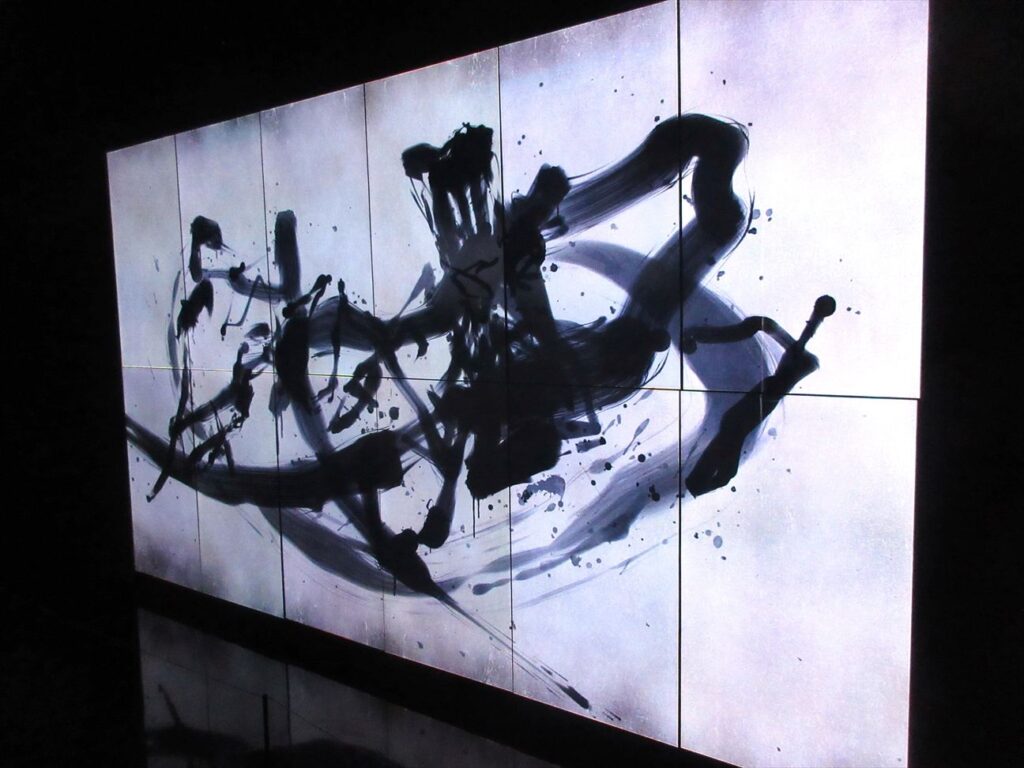
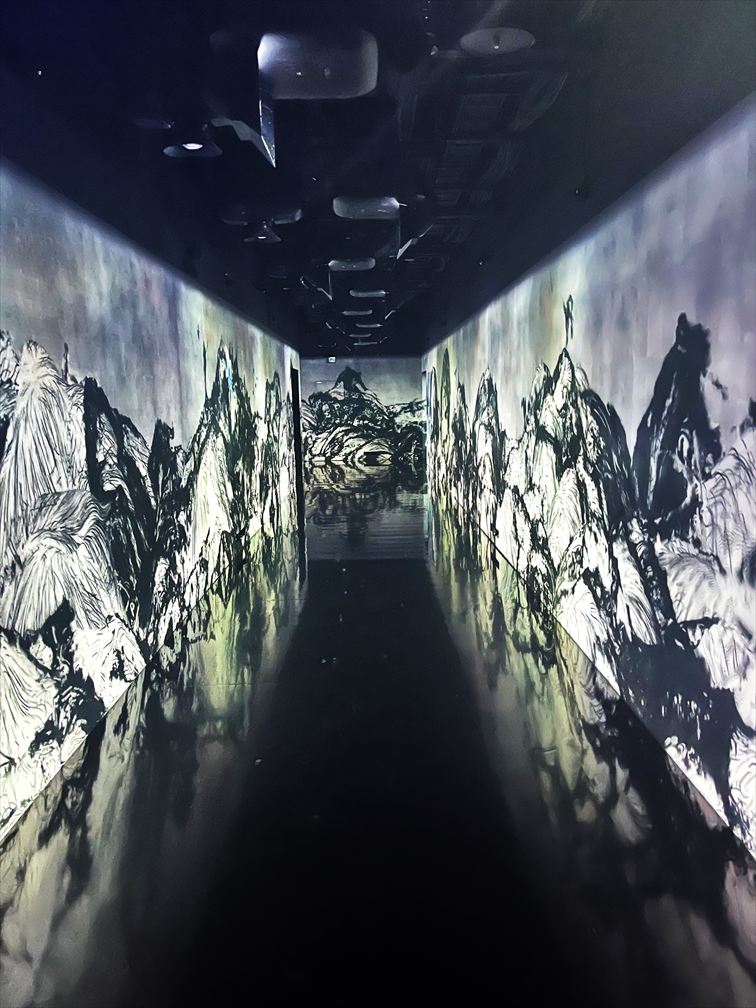
Ink Wash Painting (Sumi-e) Image
This video seems inspired by ink wash painting (sumi-e). Sumi-e came from China in the 13th century and developed in Japan from the 14th to 16th centuries. Brought by Zen monks, it uses only black and white. Among the colorful digital works, this piece makes a strong impression.
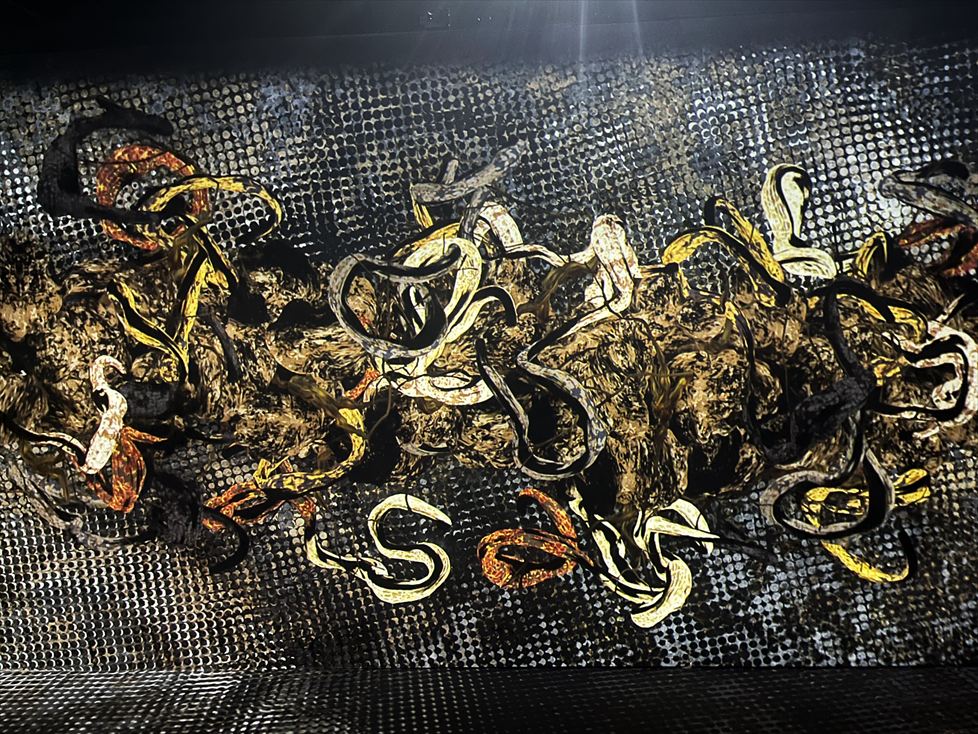
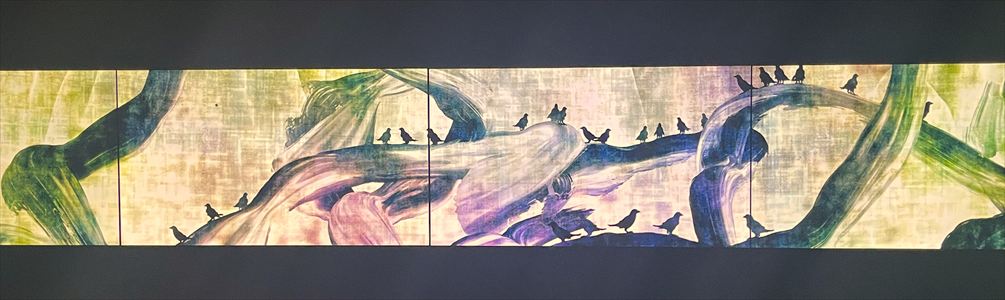
Snake or Tree Motif Image
This is a moving work, yet it also works as a still image. The artwork features a snake or a tree as its main motif, which makes a strong impression.
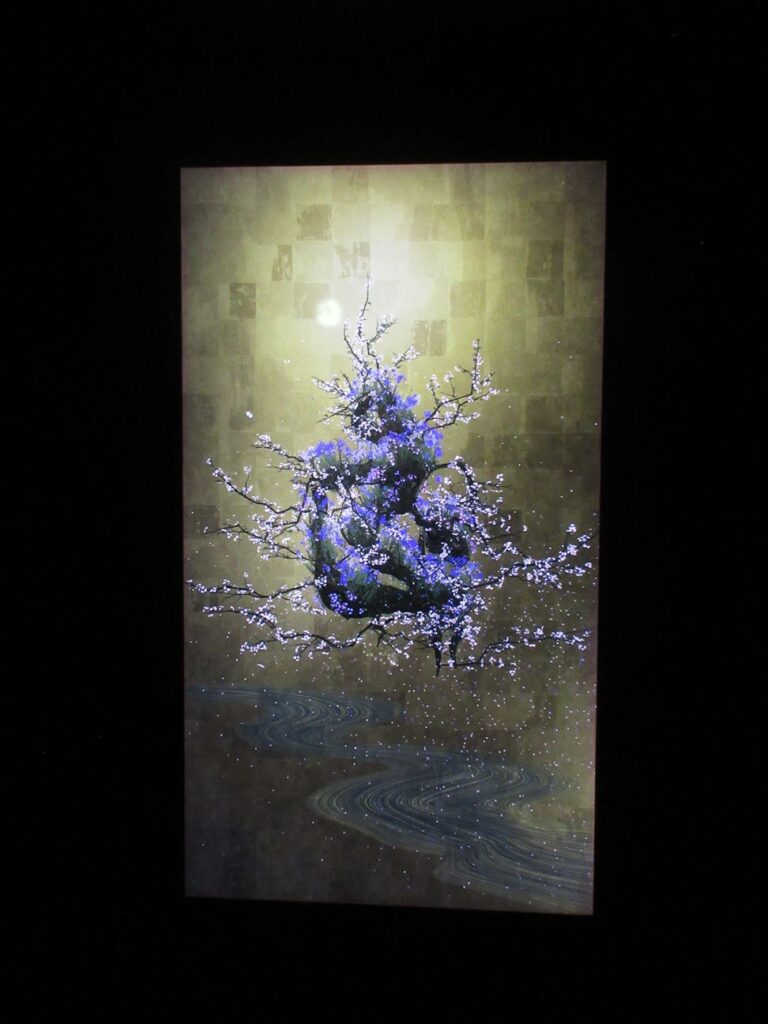
Potted Plants and Bonsai
This work was placed near the restroom, but it could easily stand alone in a museum. The image slowly rotates, adding to its unique presence.
Video of Humans and Animals Marching
This video is also in black and white. I could see frogs, rabbits, cows, bears, and boars walking alongside humans. The key of the piece seems to be the coexistence of humans and animals. The video appears on a wall in one room, but it seems to wander between rooms. At first, it crossed a room with the largest colorful projection, and I couldn’t take my eyes off it. Later, I saw it march across another space, and again I was moved to tears. Most visitors here are foreign, but anyone who has lived in Japan might understand why this scene touched me so deeply.
Cafe
At the very back, there is a café. The room has no lighting. Sensors on the ceiling react to drinks served in glass containers, projecting images of flowers onto the drinks. The technology feels highly advanced. Because it uses light in this way, the room is completely dark, yet the space is relaxed, with seating arranged comfortably. I also noticed that each chair has only one armrest, making it easier to sit down.
The museum covers about 7,000 m², roughly 100 m by 70 m. There is no map, and the darkness makes it easy to get lost, so the space feels even larger. I imagine many visitors lose their way inside.
A good museum is often characterized by a complex layout, and this museum definitely had that. The entrance and exit are unclear, which also adds to its quality. As mentioned earlier, Azabudai Hills itself has a complex layout, making it hard to find your way. I felt this actually aligns with the concept of teamLab Borderless. Consistency like this is surprisingly important, and it made sense to me personally.
Most visitors inside were foreigners—I’d guess over 80%. I’ve highlighted the works I personally liked, but their impact depends on whether you understand or are interested in Japanese culture. For this reason, I think Japanese visitors should also come and see how it feels. Even those who usually resist digital art should give it a try.
The museum is very popular, so it’s likely to be crowded. You won’t find empty, quiet spaces, which is a bit disappointing, but unavoidable.
Finally, I felt that maintaining the system running this space must be very challenging. If something breaks, the whole setup could fail. I imagine they pay close attention to both system quality and risk management.
Visited in 2025
Basic Information
■ Name : teamLab Borderless (Azabudai-Hills)
■ Address : Azabudai Hills Garden Plaza B B1, 5-9, Toranomon, Minato-ku, Tokyo
■ Homepage : https://www.teamlab.art/e/tokyo/
■ Others
1) I visited in winter around 6 PM, and it was relatively quiet, but it still took me about two hours to see everything. Some rooms have staff controlling entry, but I had almost no wait. During busy times, I imagine lines would form. Based on this, plan at least 2 hours, or around 3 hours when it’s crowded.
2) The café at the back charges for food and drinks. It offers drinks including matcha-based options, which are surprisingly authentic. The café space feels mysterious and unique. It’s worth paying for—definitely try it.